Indra Group’s profitability accelerates and improves in the second quarter of 2026, with double-digit increases in its order intake, revenues, and EBIT
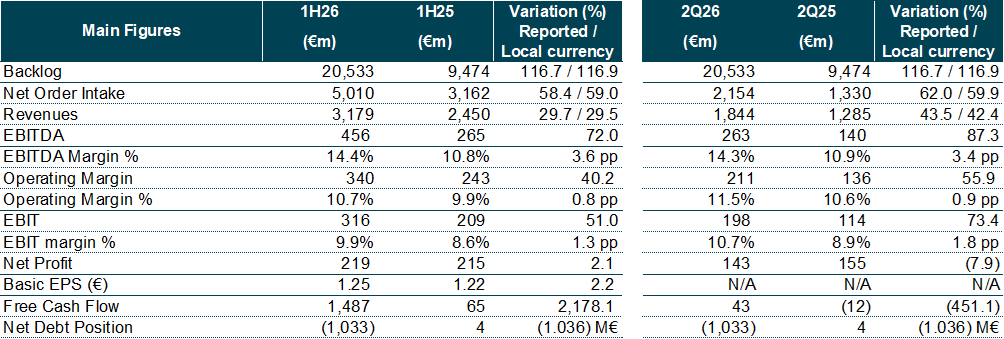
The backlog reaches €20.533 billion in the first half of the year, set against the figure of €9.474 billion recorded in the same period of the previous one, with all of the divisions contributing to the growth.
The order intake over the six months rises by 58% and stands at €5.010 billion, with its growth speeding up in the second quarter (62%).
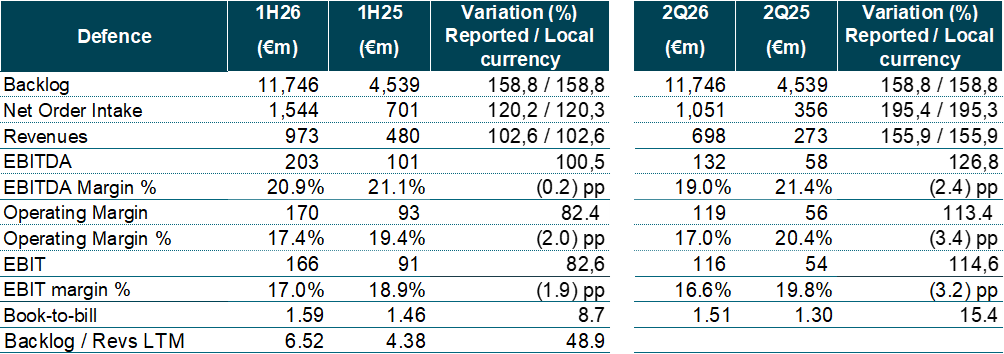
Revenues increase by 30% in the first six months compared to the same period of 2025, with year-on-year increases in all of the divisions, including Defence (103%) and ATM (16%).
The EBITDA and EBIT record respective 72% and 51% year-on-year increases and improve Indra Group’s profitability by 1.3 percentage points, equivalent to a 9.9% EBIT margin in the first half of the year, set against the figure of 8.6% in the same months of 2025.
The net result totals €219 million, 2% more than in the first six months of 2025, while the free cash flow (FCF) stands at €1.487 billion, compared to the figure of €65 M in the same period of 2025.
The sale of the BPO business is completed and an agreement for the sale of Minsait Business Consulting is announced in the second quarter.
The company reaffirms all of its financial targets in 2026: over €7 billion in revenues in local currency, an EBIT over €700 million, and a free cash flow amounting to over €375 million.
Revenues increased by 30%, totaling €3.179 billion in the first half of the year
The company reaffirms all of its financial targets for 2026
| Indra Group Chief Executive Officer (CEO) Josep Maria Recasens declared: “The results in the second quarter of the year clearly demonstrate Indra Group’s industrial capabilities and its ability to execute and deliver the contracts in its backlog in due time and manner, enabling us to once again confirm our objectives for the 2026 financial year as a whole, and, at the same time, constitute an excellent starting point for our new Strategic Plan, intensive work on which has already begun. Our first management priority can be none other than excellence in our execution and improving our speed of delivery, quality, reliability, and competitiveness. But this excellence will only fulfill its full potential if we put it at the service of an unequivocal vocation and responsibility to structure and drive the Spanish defence ecosystem, enhancing its capabilities and generating the scale required to compete in an increasingly demanding environment.To achieve the foregoing, we must forge solid partnerships and cooperative relationships at home and abroad so as to multiply our capabilities and drive innovation, allowing us to successfully address the major programs of the future. Only through collaboration, trust, and shared ambition can we establish ourselves as a flagship international company and contribute to reinforcing Spanish and European technological and industrial sovereignty. We’ll continue to improve and enhance our industrial and technological capabilities in order to harness the unique opportunities for growth provided by the Defence, Aerospace, and Technology sectors”. |
Acquisitions contributed €377 million to sales in the first half of 2026 vs. €6 million in the same period of 2025. The acquisitions of TESS Defence and AERTEC contributed inorganically to Defence, Hispasat and Hisdesat contributed to Space, and Micronav and Global ATS contributed to ATM. As for divestments, Minsait’s BPO division contributed €62 million to sales in the first half of the year, compared to €95 million in the same months of the previous one.
Highlights of the period
The backlog in the first half of 2026 totaled €20.533 billion, a 117% increase compared to the first six months of 2025, driven mainly by Defence (a rise of €7.207 billion), the inorganic contribution of Space (the consolidation of the Hispasat and Hisdesat backlog totaling €2.722 billion), and the Transport for London contract in Mobility (€605 M). All of the other divisions also contributed to the growth. The ratio between the backlog and sales in the last twelve months stood at 3.32x, set against the figure of 1.90x in the same period of the previous year.
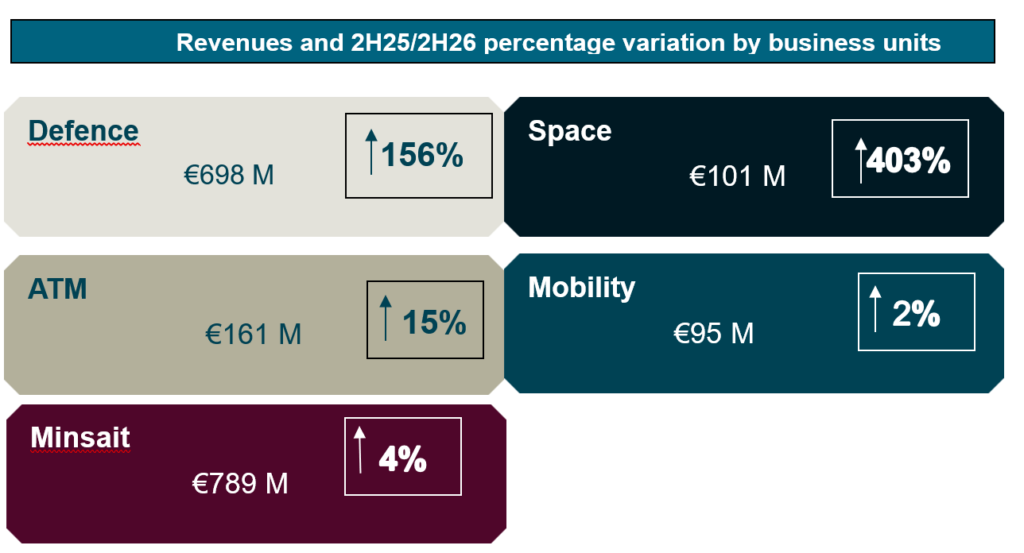
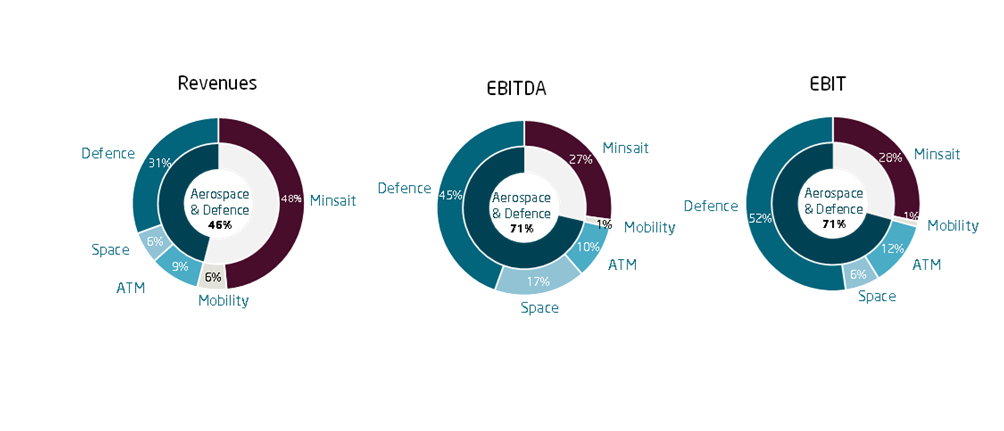
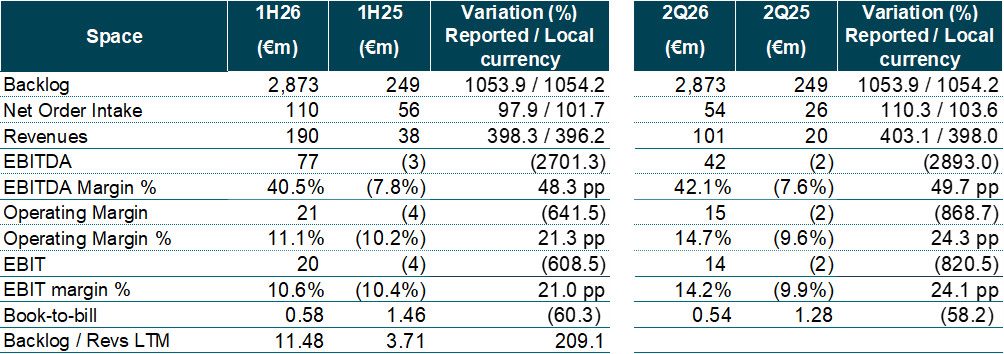
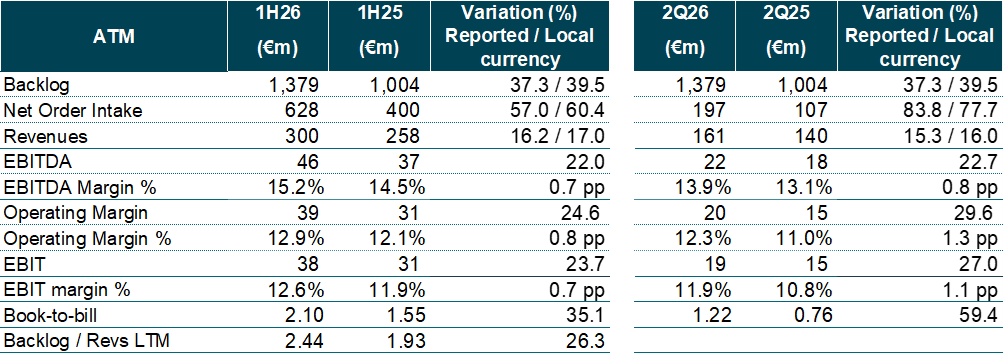
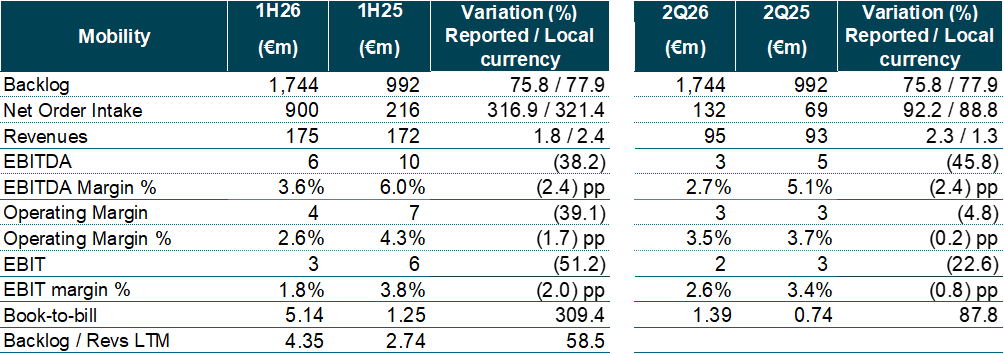
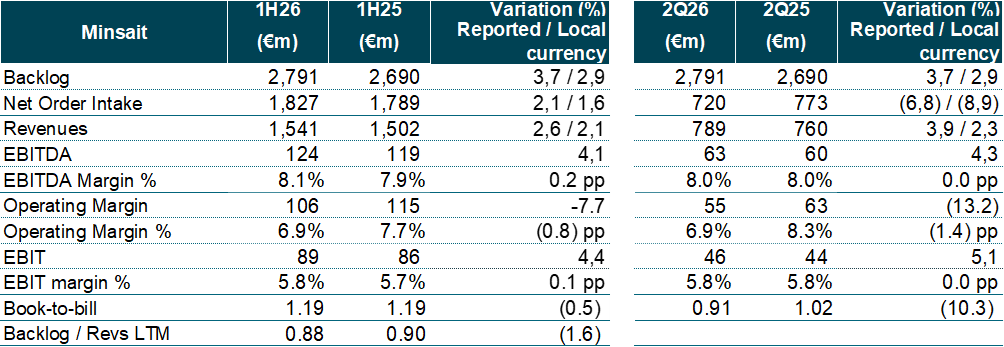
Revenues until June 2026 rose by 30%, with all of the divisions displaying increases: Space grew by 398%, Defence by 103%, ATM by 16%, Minsait by 3%, and Mobility by 2%. Meanwhile, the year-on-year growth of revenues in the second quarter of the year stood at 43%, similarly driven by all of the divisions: Defence grew by 156%, Space by 403%, ATM by 15%, Mobility by 2%, and Minsait by 4%.
- Defence (+156%). Revenues rose sharply, driven by the contribution of the Land Vehicles business, the Special Modernization Programs and the positive evolution of the Eurofighter program, in addition to the progress of the radar projects in Germany and Ukraine. Meanwhile, the FCAS program made a smaller contribution than the one recorded in the same period of 2025.
- Space (+403%). Revenues increased, due to the inorganic contribution of Hispasat and Hisdesat, with significant influence displayed by the businesses in Spain and the Americas (the managed services businesses in Mexico, Brazil and Peru). The progress was also significant in Europe, due to the inorganic contribution of Germany (Axess) and the Galileo program.
- ATM (+15%). Revenues advanced with double-digit growth, particularly in AMEA, driven by the radar projects in Azerbaijan and the United Arab Emirates and the upgrading of the air traffic management systems in Vietnam. Growth in the Americas was based on the radar and radio contracts in the United States, Canada, and Brazil.
- Mobility (+2%). Revenues recorded moderate growth, driven by the good performance of the toll and traffic control systems in the Americas and the ticketing and Intelligent Transport Systems businesses in Spain. This progress was partially restricted by the falls in Europe, mainly due to the ticketing in Ireland, and in AMEA, due to the lower activity on the Saudi Arabian rail network.
- Minsait (+4%). Revenues grew, driven by the solid performance of the Public Administration and Healthcare business, which recorded a double-digit rise. This growth offset the more moderate performance of Financial Services and the falls recorded by Energy and Industry and, especially, Telecommunications and Media. Organic growth also maintained a positive trend during the period.
The exchange rate contributed €6 million to revenues during the first half of 2026 (+0.3 pp), chiefly due to the appreciation of the currencies of Colombia, Mexico, and Brazil vis-à-vis the euro.
Organic revenues in the first part of the year (excluding the inorganic contribution of acquisitions and divestments and the effect of the exchange rate) rose by 16%, with significant increases in Defence (59%) and ATM (15%), and others totaling 5% in Minsait and 2% in Mobility. In turn, the organic revenues of Space fell by 14% over the six months.
The net order intake in the first six months of 2026 increased by 58%, with significant growth in all of the businesses, particularly Mobility (which rose by 317%), mainly driven by the management contract for London’s transport network in the United Kingdom (€605 million corresponding to the Transport for London project), the railway system contract in Saudi Arabia (€126 million for the Mecca-Medina high-speed train project), and the ticketing contract in Washington in the United States (Transport for Washington, €33 million). Meanwhile, the order intake in Defence increased by 120%, mainly due to the significant contribution of the Eurofighter project, the Special Modernization Programs (SMPs) totaling €171 million and the Simulation business (the SMP for the advanced integrated flight training system as an Airbus subcontractor).
The order intake in Space rose by 98% thanks to the Americas, due to Hispasat’s services business in Peru and Hisdesat in Spain, while it increased by 57% in ATM, due in particular to the surveillance radar contract with the FAA in the United States, as well as the radar manufacturing contracts for the airport in the United Arab Emirates, the radio contracts in Egypt and various contracts in Spain. Finally, the order intake at Minsait increased by 2%, thanks to the 13% rise in Financial Services and that of 11% in Public Administration & Healthcare.
As a result, the book-to-bill order intake ratio with respect to sales stood at 1.58x vs. 1.29x in the first half of 2025.
The EBITDA margin stood at 14.4% at the end of the first half of the year, compared to the figure of 10.8% recorded in the first six months of 2025, with a 72% EBITDA increase in absolute terms. These improved margins can mainly be put down to the greater growth in revenues recorded in the divisions with the largest margins (Defence and ATM), as well as the inorganic contribution of Hispasat and Hisdesat. If we exclude the impact of TESS, the EBITDA margin in this period would have stood at 15.3%. In the second quarter of the year, the EBITDA margin stood at 14.3% (15.8% excluding the above impact) vs. 10.9% in the same quarter of 2025, with 87% EBITDA growth in absolute terms.
The operating margin until June 2026 was 10.7%, compared to 9.9% in the same period of the previous year, with 40% growth in absolute terms. Other operating income and expenses (the difference between the operating margin and the EBIT) totaled -€24 million vs. -€33 million in the first half of 2024, with the following breakdown: -€17 million for workforce restructuring costs vs. -€20 million; the impact of the PPA (Purchase Price Allocation) on the amortization of the intangibles totaling -€9 million vs. -€8 million, and the provision for the stock-based compensation of the medium-term incentive amounting to -€6 million (the same figure as in 2025, in line with the first half of 2025 and, finally, the effect of the sale of the BPO business, which generated a €7 million profit.
The EBIT margin stood at 9.9% in the first six months of the year (10.6% excluding the impact of TESS), compared to the figure of 8.6% in the same period of 2025, with the EBIT displaying a 51% increase in absolute terms). With respect to the second quarter, the margin stood at 10.7% (11.9% excluding the above impact), compared to 8.9% in the same months of the previous year, with the EBIT increasing by 73% in absolute terms.
The net result in the first six months of 2026 stood at €219 million compared to €215 million in the same period of the previous year, constituting a 2% increase, mainly as a result of the operational improvement.
The free cash flow over the same months stood at €1.487 billion vs. €65 million in 2025, mainly driven by the advance payments received for the Special Modernization Programs. If we exclude the net impact of the working capital of these programs and consider a constant historical factoring totaling €187 million (as recorded at the closure of all of the quarters in previous years), the company’s FCF would have stood at €15 million in the first part of the year.
As for the net debt, the group ended June 2026 with a positive Net Cash position amounting to €1.003 billion, compared to the €583 million net debt and the positive Net Cash position totaling €4 million recorded in June 2025. The Net Debt/LTM EBITDA ratio (excluding the IFRS 16 impact) stood at -1.3x in June 2026, compared to 1.0x in December 2025 and 0.0x in June 2025.
| Goals for 2026 • Revenues in local currency1: greater than €7 billion. • Reported EBIT²: greater than €700 million. • Reported Free Cash Flow3: greater than €375 million. ¹ Includes the consolidation of BPO until its sale ² Does not include the one-off result of the sale of the BPO asset ³ Excludes the advances from Indra’s defence programs (SMPs) and the joint ventures it participates in, and considers constant factoring (€187 M) |
Other events during the quarter
The quarter was characterized by changes in the company’s corporate governance. Following the resignation of Ángel Escribano Ruiz as a director and the executive chairman on April 1, the Board of Directors activated the corresponding succession procedure and, the following day, appointed Ángel Simón Grimaldos as a director and the non-executive chairman of Indra Group, with José Vicente de los Mozos remaining as the company’s CEO and chief executive. The Board then initiated the selection procedure for the succession in the executive management, which culminated in the appointment of Josep Maria Recasens Laguarda as CEO, a position he took up with effect on June 17 following an orderly transition period. Further changes to the composition of the Board and its Secretariat were also made.
In the industrial and strategic sphere, Indra Group reinforced its positioning in defence through an agreement between Indra Land Vehicles and IDV, a company in the Leonardo group, for the development of the future Amphibious Combat Vehicle for the Marine Corp (VAC-IM) requested by the Ministry of Defence within the framework of a Special Modernization Program. Likewise, it reached an agreement with the European Waterland Private Equity fund for the divestment of 100% of Minsait Business Consulting.
The Ordinary General Meeting of Shareholders was held on June 30 with an attendance quorum totaling 69.34% of the share capital, during which the proposals submitted to a vote were approved by a large majority, including the distribution of a gross €0.30 dividend per share to be charged to the profits in 2025. Following the meeting, the Board of Directors ratified Josep Maria Recasens Laguarda as CEO, undertook a reorganization of its committees, and approved several measures designed to simplify and reinforce its corporate governance model.
Results by business units
Revenues by geographical regions

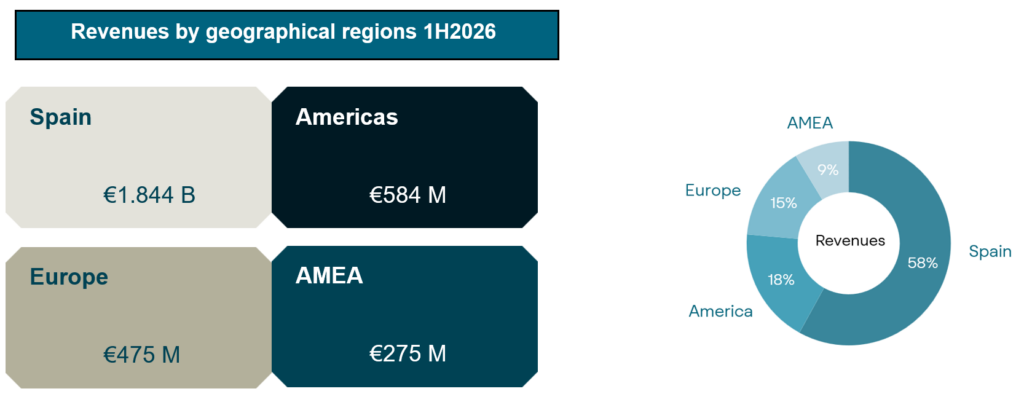
Revenues by geographical regions recorded double-digit increases in Spain (by 48%; 58% of total sales), AMEA (by 40%; 9% of total sales), and the Americas (by 20%; 18% of total sales), in contrast to the falls recorded in Europe (by 9%, equivalent to 15% of total sales).